How to Draw a 1920 Plane Right
Drafting tools may be used for measurement and layout of drawings, or to improve the consistency and speed of creation of standard drawing elements. Tools such equally pens and pencils marker the cartoon medium. Other tools such as direct edges, aid the operator in drawing straight lines, or assist the operator in drawing complicated shapes repeatedly. Various scales and the protractor are used to measure the lengths of lines and angles, allowing accurate scale drawing to be carried out. The compass is used to draw arcs and circles. A drawing lath was used to hold the cartoon media in place; later boards included drafting machines that sped the layout of straight lines and angles. Tools such equally templates and lettering guides assisted in the drawing of repetitive elements such every bit circles, ellipses, schematic symbols and text. Other auxiliary tools were used for special drawing purposes or for functions related to the grooming and revision of drawings. The tools used for manual technical drawing have been displaced by the advent of computer-aided cartoon, drafting and design (CADD).

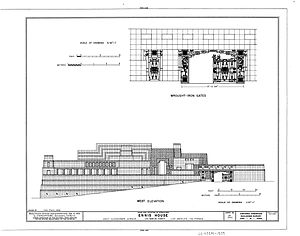
The ship's steam machinery installation drawing for the iron-clad CSS Texas, 1865
History [edit]
The aboriginal Egyptians are known to take used wooden corner rulers.[1] Ancient Nuragic people in Sardinia used compasses made of bronze, like the ane displayed in showcase 25 in the Nuragic section of the National Archeological Museum Thousand. A. Sanna in Sassari. In ancient Greece, bear witness has been found of the utilise of styli and metallic chisels, scale rulers and triangle rulers. Excavations in Pompeii have institute a statuary tool kit used by the Romans, which contained triangle rulers, compasses and a ruler to utilise with a pen.[2]
Although a variety of styli were developed in ancient times and were still beingness used in the 18th century, quills were more often than not used as the main drawing tool. Styli were also used in the form of ivory or ebony pencils.[2]
Protractors have been used to measure and draw angles and arcs of a circumvolve accurately since nigh the 13th century,[1] although mathematics and science demanded more detailed drawing instruments. The adjustable corner ruler was developed in the 17th century, but a feasible screw-tightened version not until the 1920s.[2]

Holding a ruling-pen, 1901
In the 17th century, a stylus that could describe a line with a specific width called a ruling pen was developed. The stylus had two curved metal pieces which were joined by a screw. Ink was trickled between the blades, from which it flowed evenly across the paper. The basic model was maintained for a long time, with modest modifications, until the 1930s when the German technical cartoon pens came to the market.[ii]
Artists (including Leonardo da Vinci and Albrecht Dürer, Nicholas Bion and George Adams) mostly made cartoon tools for themselves.[i] Industrial production of technical drawing instruments started in 1853, when Englishman William Stanley (1829–1909) founded a technical manufacturing company in London. Even and so, however, most tools were still made by hand.[two]
In the 1930s the equipment available expanded: drawing apparatus and Rapidograph-drawing pens appeared, improving the line quality and, especially, producing consistent line width.[2] In improver to the Rapidograph stylus, a more traditional Grafos-type stylus was used for a long fourth dimension, where different line widths were achieved by irresolute the pen nib. For instance in Finland Grafos was normally used as a primary drawing tool yet in the early 1970s.
Equipment changed radically during the 1990s, when computer-aided design nearly completely ousted drawing by hand. Technical blueprint has inverse from drawing by paw to producing computer-aided pattern drawings, where drawings are no longer "drawn", but are built from a well-nigh-produced model. Drawings are not necessarily produced in difficult copy at all, and if they are needed they are printed automatically by a computer program. Hand-drawn designs however are nonetheless widely used in the draft blueprint stage.
Drawing tools [edit]
Pencil [edit]
Traditional and typical styli used for technical cartoon are pencils and technical pens.
Video of a 1930s dotted-line drawing pen
Pencils in use are usually mechanical pencils with a standard lead thickness. The usual line widths are 0.35 mm, 0.5 mm, 0.7 mm and i.0 mm. Hardness varies usually from HB to 2H. Softer pb gives a better contrast, only harder atomic number 82 gives a more than accurate line. Bad dissimilarity of the atomic number 82 line in general is problematic when photocopying, but new scanning copy techniques have improved the final result. Newspaper or plastic surfaces require their own lead types.
-
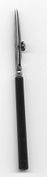
A traditional ruling pen, already in utilize in the 1600s.
-

Grafos stylus.
-

A disassembled Grafos and nibs of different widths.
-
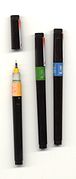
Rapidograph styli of unlike widths: 0.35, i.4 and 0.vii mm.
-

Rapidograph stylus parts. The head tin be further disassembled.

A parallel ruler-equipped drawing board. Drawing from an article published in a Norwegian technical periodical Teknisk Ukeblad in 1893. The article dealt with a new kind of vertical drawing apparatus. The lath was equipped with a lift mechanism, improving the ergonomy when doing large drawings.
In most cases, the terminal drawings are drawn with ink, on either plastic or tracing paper. The pen is generally a Rapidograph-type technical pen, a mark pen that draws lines of consistent width (and then-called steel marker pen). The pen has an ink container which contains a metal tube, inside which is a thin metal needle or wire, the soul. Ink is captivated between the needle and the tube wall, preventing an excessive amount of ink from beingness released. The needle has a weight and by waving the pen back and forth the needle is released and the ink can run. Originally, the tank was filled from an ink canteen; newer pens use ink cartridges.
Each line width has its own stylus. The line width is standardized: In Finland, the most unremarkably used set is 0.13 mm, 0.eighteen mm, 0.25 mm, 0.35 mm, 0.50 mm and 0.70 mm. Separate styli are used for tracing paper and plastic, because plastic requires a harder pen tip. To function well they crave regular maintenance, the finest marking pens in item.
Drafting board [edit]
The drawing board is an essential tool. Newspaper volition be fastened and kept straight and still, and then that the cartoon can be done with accuracy. By and large, different kind of help rulers are used in cartoon. The drawing board is usually mounted to a floor pedestal in which the board turns to a different position, and also its height tin exist adjustable. Smaller drawing boards are produced for table-top utilise. In the 18th and 19th centuries, drawing newspaper was dampened and and so its edges glued to the drawing board. After drying the newspaper would exist flat and shine. The completed drawing was then cutting free.[iii] : 1-ii Paper could also be secured to the drawing board with drawing pins[iv] or fifty-fifty C-clamps. More recent practise is to use self-adhesive drafting tape to secure paper to the lath, including the sophisticated utilize of individualized agglutinative dots from a dispensing roll. Some cartoon boards are magnetized, allowing newspaper to be held down by long steel strips. Boards used for overlay drafting or animation may include registration pins or peg bars to ensure alignment of multiple layers of drawing media.
T-square [edit]
A T-square is a straightedge which uses the edge of the drawing lath as a support. It is used with the drafting lath to draw horizontal lines and to marshal other drawing instruments. Wooden, metallic, or plastic triangles with 30° and 60° angles or with two 45° angles are used to speed drawing of lines at these commonly used angles. A continuously adjustable 0–ninety° protractor is also in utilise. An alternative to the T-square is the parallel bar which is permanently attached to the drawing board. It has a prepare of cables and pulleys to allow it to exist positioned anywhere on the drawing surface while still remaining parallel to the bottom of the lath. The drafting motorcar replaces the T-foursquare and triangles.
Drafting car [edit]

Correct-handed parallelogram machine with a ballast.
A drafting auto is a device which is mounted to the drawing lath. It has rulers whose angles tin be precisely adjusted with a controlling mechanism. [5] There are two principal types of appliance: an arm-type parallelogram apparatus based on a hinged arm; and a runway-type apparatus which moves on a rail mounted to the top of the drawing board. The accuracy of the arm type apparatus is better in the centre of the board, decreasing towards the edges, whereas a track machine has a constant accuracy over the whole board. The cartoon head of a runway-type drafting machine slides on bearings in a vertical rail, which in plough is moved along a horizontal, acme-mounted rail. Both apparatus types have an adaptable drawing-head with rules attached to a protractor scale so that the angle of the rules may exist adjusted.[6] : 35–36
A drafting car allows piece of cake drawing of parallel lines over the paper. The adaptable angle betwixt the rulers allows the lines to be fatigued in varying accurate angles. Rulers may also be used as a support for separate special rulers and letter templates. The rules are replaceable and they can be for example scale-rules.
Drawing appliance has evolved from a drawing board mounted parallel ruler and a pantograph, which is a device used for copying objects in an adjustable ratio of sizes.
French curves [edit]
French curves are made of wood, plastic or celluloid. Some set squares also have these curves cutting in the eye. French curves are used for cartoon curves which cannot be drawn with compasses. A faint freehand curve is first drawn through the known points; the longest possible curve that coincides exactly with the freehand curve is and so plant out from the French curves. Finally, a not bad continuous curve is fatigued with the assistance of the French curves.[7] : 12–thirteen
Rulers [edit]
Rulers used in technical cartoon are commonly made of polystyrene. It is used for drawing lines and connecting points. Rulers come in two types according to the design of their edge. A ruler with a direct border can be used with lead pencils and felt pens, whereas when a technical pen is used the edge must be grooved to prevent the spread of the ink.

A scale ruler is a scaled, three-edged ruler which has six different scales marked to its sides. A typical combination for edifice details is ane:20, 1:50, one:100, 1:25, 1:75 and 1:125. In that location are separate rulers for zoning work likewise as for inch units. Today scale rulers are made of plastic, formerly they were made of hardwood. A modest version is too available, with scales printed on flexible plastic strips.

View of a drafting table: the former way of producing architectural and engineering drawings. On the elevation of the lath is a parallel ruler.
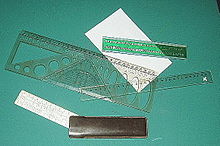

Various curved rulers, commonly known as French curves. This image comes from the Lexikon der gesamten Technik (dictionary of applied science) from 1904 by Otto Lueger
Compass [edit]
Compasses are used for cartoon circles or arc segments of circles. One form has two straight legs joined past a hinge; one leg has a precipitous pin point and the other has a holder for a technical pen or pencil. Another form, the axle compass, has the pivot indicate and pen holder joined by a trammel bar, useful when drawing very large radius arcs. Often a circle template is used instead of a compass when predefined circle sizes are required.
Templates [edit]
Templates contain pre-dimensioned holes in the right calibration to accurately describe a symbol or sign.
Letter templates are used for drawing text, including digits and letter characters. Diagrams are normally of a standard alphabetic character shape and size to conform to standards of encodings (e.m. DIN or ANSI). For case, in Republic of finland the serial used is ane.eight mm, 2.5 mm, iii.5 mm, 5.0 mm and 7.0 mm. Except for the very biggest ones, the templates are only suitable for technical pen drawing.
For cartoon circles and circle-arcs, circumvolve templates which contain a set up of suitably-sized holes are used. Templates are too bachelor for other geometric shapes such as squares and for drawing ellipses, as well as many specialized varieties for other purposes.
There are also specific templates to provide user with the most mutual symbols in use in different branches of designing. For case, the architect templates can exist used to draw different sized doors with their "opening arcs", building and equipment symbols and furniture. The templates also provide the symbols for thermal insulation.
Two methods of drawing smooth curves in transmission drafting are the use of French curves and flat splines (flexible curves). A French bend is a cartoon help with many different smoothly-varying radiused curves on it; the manual drafter can fit the French bend to some known reference points and depict a smooth curved line between them. A spline is a flexible ruler, usually rubber or plastic coated with a metallic "backbone", which can be smoothly shaped to follow a desired curve and allows drawing a smooth line between initial reference points. Sometimes a spline is temporarily held in position with small weights.
Perspective machines [edit]
A perspective automobile is an instrument designed to create perspective drawings.[eight]
Drawing materials [edit]
Drafting paper [edit]
Silk-paper-like translucent drafting paper that wrinkles when wetted. It is primarily suitable for pencils and felt tip pens. Pencil marks can be corrected to some extent with an eraser.
Thick draft paper [edit]
Sandwich-paper-like, thin translucent sheet of paper. Manufactured in dissimilar strengths, the surface may be slightly polished. This paper also wrinkles upon wetting. Suitable for pencil and felt tipped pens, and with limitations for technical pens. An eraser tin can be used for pencil lines. Ink is difficult to erase without damage.
Cloth [edit]
Drafting linen was formerly used for technical drawings. It was durable and held upwards to handling, simply it was difficult to use in modern whiteprints for reproduction, and shrinking was a concern.
Tracing newspaper [edit]
Polished sandwich newspaper-like, translucent thick paper, which comes in dissimilar strengths. Wrinkles upon wetting. Suitable for both graphite pencils and technical pens. An eraser or sharp scraper tool is used for corrections.
Tracing tube [edit]
Translucent plastic motion-picture show, which is usually of gray or a light khaki shade. Common types are 0.05, 0.07 and 0.10 mm thick. These films are also used in photocopying. The most ordinarily used materials are polyesters, and sometimes also PVC or polycarbonate; arguably, a proprietary eponym or genericized trademark for this is called Mylar.
Inks [edit]
Drawing inks can be divided into two groups: Bharat ink and polymer inks. Bharat ink is used on paper and drafting motion picture plastics. The most commonly used Bharat ink is a colloidal mixture of water and carbon blackness.
Dry transfer [edit]
Dry transfer decals can speed the product of repetitive drawing elements such equally borders, championship blocks, line types, shading, and symbols. They were often used in the production of schematic drawings, maps, and printed circuit lath artwork, for case. Dry out transfer lettering such as Letraset was used especially in lettering larger size document annotations, or when consistency of lettering was specially required.
Reproduction [edit]
Many copies of technical drawings may be required in the construction of a projection. Reproductions must be accurate every bit to size and shape, but for many purposes need non exist permanent. The blueprint process was first used for mechanical reproduction of drawings. Cartoon offices may use diazo or whiteprint processes. Where the volume of drawings reproduced justifies the cost of the machine, a big format photocopier using xerography can reproduce drawings at lower cost than re-plotting them.
See as well [edit]
- Architectural drawing – Technical drawing of a building (or building projection)
- Architectural reprography
- Drawing – Visual artwork in two-dimensional medium
- Figurer-aided design – Amalgam a production by means of computer
- Isometric project – Method for visually representing three-dimensional objects
- Orthographic project – Means of projecting three-dimensional objects in 2 dimensions
References [edit]
- ^ a b c Hartenberg, Richard S. (16 January 2019). "hand tool". Encyclopedia Britannica. Archived from the original on 12 Nov 2021. Retrieved 11 Jan 2022.
- ^ a b c d e f Higgott, Gordon (1 March 1990). "Review: Cartoon Instruments, 1580–1980 by Maya Hambly". Journal of the Society of Architectural Historians. The Gild of Architectural Historians. 49 (one): 111–112. doi:10.2307/990507. eISSN 2150-5926. ISSN 0037-9808. JSTOR 990507.
- ^ Heather, John Fry (1884). Mathematical Instruments: Their Construction, Adjustment, Testing and Use: Comprising Drawing, Measuring, Optical, Surveying, and Astronomical Instruments . Weale's scientific & technical serial. Crosby, Lockwood and Co. pp. i–2. ISBN978-0344280559. LCCN 05025600. OCLC 222119838. OL 32907144M – via Internet Annal.
- ^ The American Engineer. Vol. nineteen–xx. Arkose Press. 1890. p. 107. ISBN978-1345665802.
- ^ Lehtinen, Marja; Grönros, Eija-Riitta; Oy, Kielikone (2004). Kielitoimiston sanakirja [Dictionary of Contemporary Finnish] (in Finnish). Found for the Languages of Finland. ISBN978-9525446111. OCLC 937162846.
- ^ Jefferis, Alan; Madsen, David A. (6 December 2004). Architectural Drafting and Design (5th ed.). Cengage Learning. ISBN978-1401867157. LCCN 2004022040. OCLC 1023838948. OL 8368905M.
- ^ Bhatt, N. D. (sixteen May 2010). Technology Drawing Plane and Solid Geometry. Charotar Publishing House. ISBN978-1401867157. OCLC 764615066. OL 32444127M.
- ^ "Perspective Machine", The New and Consummate American Encyclopedia, John Low, 1810, p. 441
Further reading [edit]
- van der Does, Jan; van Haaften, Adriaa; Kegel, Rudi (1999). Presentation techniques . Publicatieburo Bouwkunde. ISBN978-9052691435. OCLC 840364117.
- Heikkilä, Matti (2001). Tekniset piirustukset [Technical drawings] (in Finnish). WSOY. ISBN978-9510264720. OCLC 58364771.
- Pere, Aimo (in Finnish) Koneenpiirustus 1 & 2 (Machine Drawing 1 & two) Kirpe, 2004. ISBN 951-97096-0-half-dozen
External links [edit]
- Kliphardt, Raymond A. (22 January 2019). "drafting". Encyclopedia Britannica. Archived from the original on 14 October 2021. Retrieved 11 January 2022.
johnstonfainterep.blogspot.com
Source: https://en.wikipedia.org/wiki/Technical_drawing_tool
0 Response to "How to Draw a 1920 Plane Right"
Enviar um comentário