Marble Bust of a Man Mid 1st Century Marble 14 38 Inches the Metropolitan Museum of Art
The summit famous sculptures of all time
From pre-history to the 21st century, here are the top famous sculptures of all time

Unlike a painting, sculpture is three dimensional fine art, assuasive y'all to view a piece from all angles. Whether celebrating an historic figure or created as a work of fine art, sculpture is all the more powerful due to its physical presence. The top famous sculptures of all time are instantly recognizable, created past artists spanning centuries and in mediums ranging from marble to metal.
Similar street fine art, some works of sculpture are large, assuming and unmissable. Other examples of sculpture may be fragile, requiring shut study. Right hither in NYC, yous can view important pieces in Cardinal Park, housed in museums like The Met, MoMA or the Guggenheim, or as public works of outdoor art. Nigh of these famous sculptures tin exist identified past even the most casual viewer. From Michaelangelo'southward David to Warhol's Brillo Box, these iconic sculptures are defining works of both their eras and their creators. Photos won't do these sculptures justice, so whatsoever fan of these works should aim to run into them in person for full result.
Top famous sculptures of all time
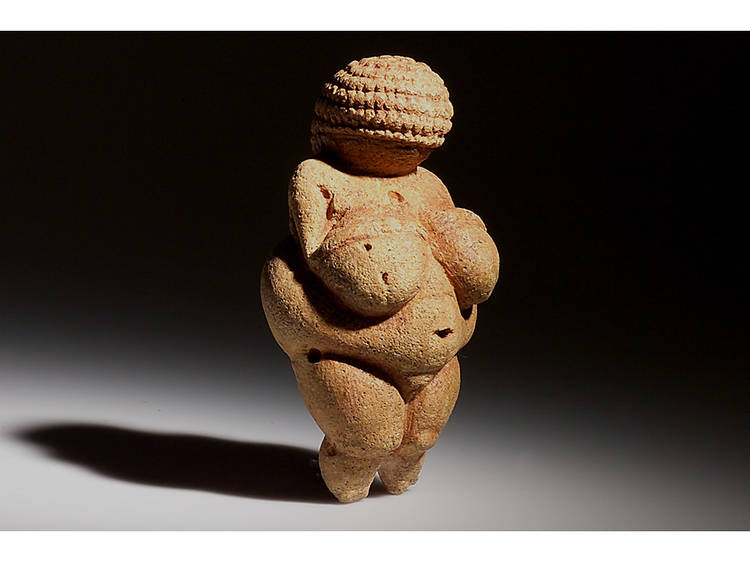
1. Venus of Willendorf, 28,000–25,000 BC
The ur sculpture of art history, this tiny figurine measuring simply over four inches in height was discovered in Republic of austria in 1908. Nobody knows what function information technology served, simply guesswork has ranged from fertility goddess to masturbation aid. Some scholars advise it may accept been a self-portrait made by a woman. It's the most famous of many such objects dating from the Old Stone Age.
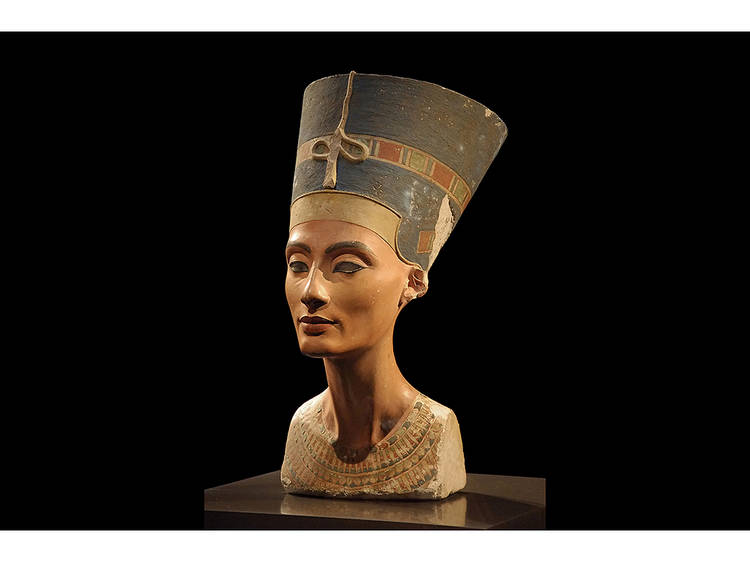
2. Bust of Nefertiti, 1345 BC
This portrait has been a symbol of feminine beauty since it was start unearthed in 1912 within the ruins of Amarna, the upper-case letter urban center congenital by the nearly controversial Pharaoh of Ancient Egyptian history: Akhenaten. The life of his queen, Nefertiti, is something of mystery: It's thought that she ruled as Pharaoh for a time afterwards Akhenaten's expiry—or more probable, as the co-regent of the Male child King Tutankhamun. Some Egyptologist believe she was actually Tut'south mother. This stucco-coated limestone bust is thought to exist the handiwork of Thutmose, Akhenaten'south court sculptor.
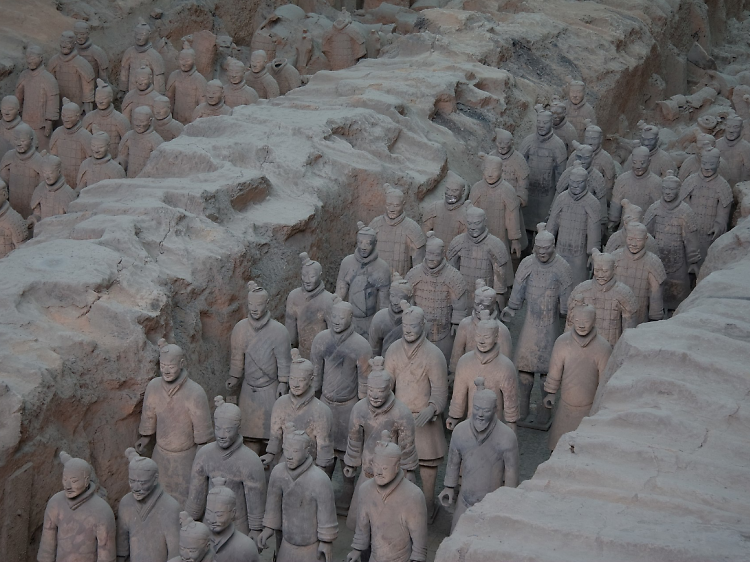
3. The Terracotta Regular army, 210–209 BC
Discovered in 1974, the Terracotta Regular army is an enormous cache of clay statues buried in three massive pits nearly the tomb of Shi Huang, the showtime Emperor of Cathay, who died in 210 BC. Meant to protect him in the afterlife, the Army is believed by some estimates to number more than eight,000 soldiers along with 670 horses and 130 chariots. Each is life-size, though actual height varies according to war machine rank.
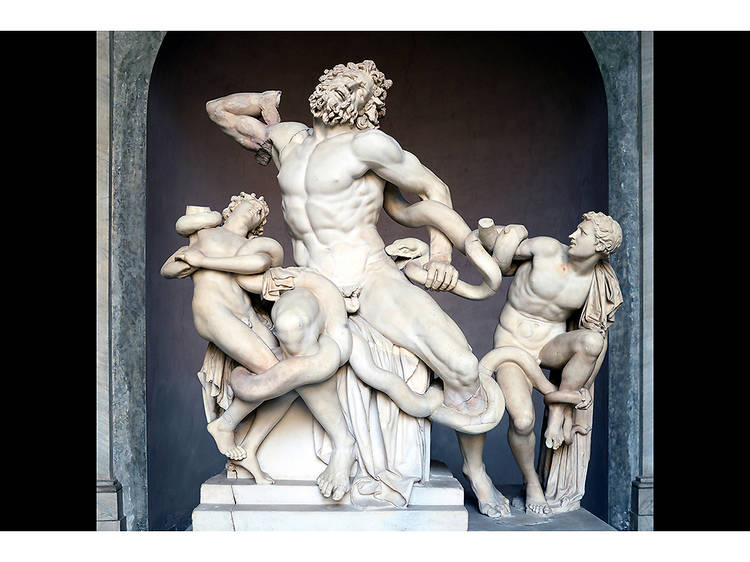
4. Laocoön and His Sons, 2nd Century BC
Perchance the well-nigh famous sculpture of Roman antiquity, Laocoön and His Sons was originally unearthed in Rome in 1506 and moved to the Vatican, where information technology resides to this twenty-four hours. Information technology is based on the myth of a Trojan priest killed along with his sons by sea serpents sent past the bounding main god Poseidon as retribution for Laocoön's effort to expose the ruse of the Trojan Horse. Originally installed in the palace of Emperor Titus, this life-size figurative grouping, attributed to a trio of Greek sculptors from the Island of Rhodes, is unrivaled as a study of human suffering.
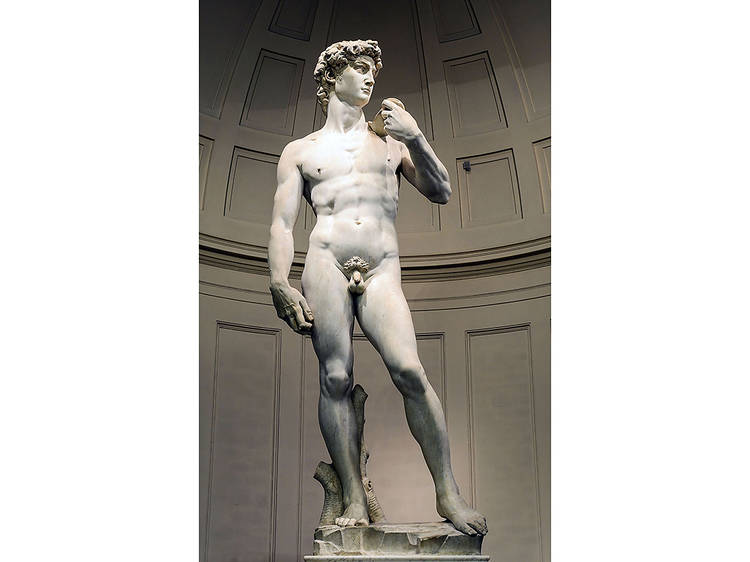
5. Michelangelo, David, 1501-1504
I of the almost iconic works in all of art history, Michelangelo's David had its origins in a larger project to decorate the buttresses of Florence'due south dandy cathedral, the Duomo, with a group of figures taken from the Old Testament. The David was one, and was actually begun in 1464 by Agostino di Duccio. Over the next ii years, Agostino managed to rough out part of the huge block of marble hewn from the famous quarry in Carrara earlier stopping in 1466. (No 1 knows why.) Another artist picked upwards the slack, but he, as well, only worked on it briefly. The marble remained untouched for the next 25 years, until Michelangelo resumed etching it in 1501. He was 26 at the time. When finished, the David weighed six tons, meaning it couldn't be hoisted to the cathedral'due south roof. Instead, it was put on display just outside to the entrance to the Palazzo Vecchio, Florence's town hall. The figure, i of the purest distillations of the Loftier Renaissance mode, was immediately embraced by the Florentine public as a symbol of the city-country's ain resistance against the powers arrayed against information technology. In 1873, the David was moved to Accademia Gallery, and a replica was installed in its original location.
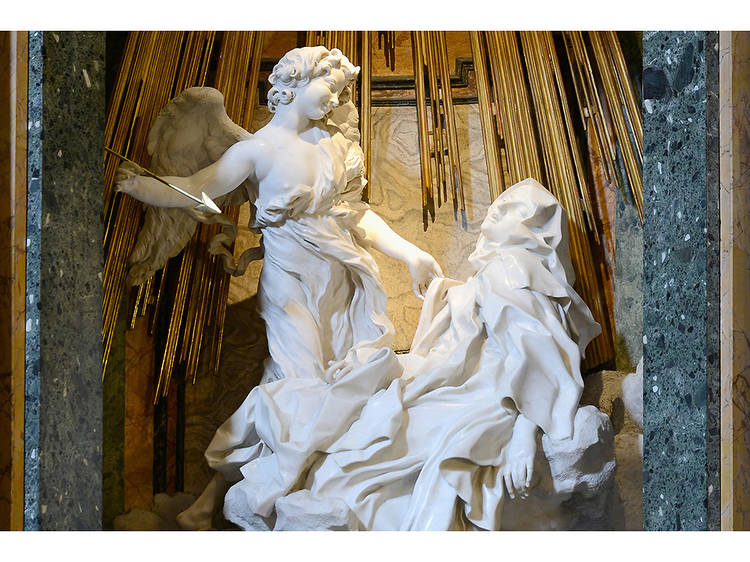
6. Gian Lorenzo Bernini, Ecstasy of Saint Teresa, 1647–52
Acknowledged every bit an originator of the High Roman Bizarre mode, Gian Lorenzo Bernini created this masterpiece for a chapel in the Church of Santa Maria della Vittoria. The Bizarre was inextricably linked to the Counter-Reformation through which the Cosmic Church tried to stem the tide of Protestantism surging beyond 17th-century Europe. Artworks similar Bernini's was part of the program to reaffirm Papal dogma, well served here by Bernini's genius for imbuing religious scenes with dramatic narratives. Ecstasy is a case in point: Its bailiwick—Saint Teresa of Ávila, a Spanish Carmelite nun and mystic who wrote of her encounter with an angel—is depicted just as the angel is about to plunge an pointer into her middle. Ecstasy's erotic overtones are unmistakable, nearly plainly in the nun'south orgasmic expression and the writhing material wrapping both figures. An builder as all as an artist, Bernini also designed the setting of the Chapel in marble, stucco and pigment.
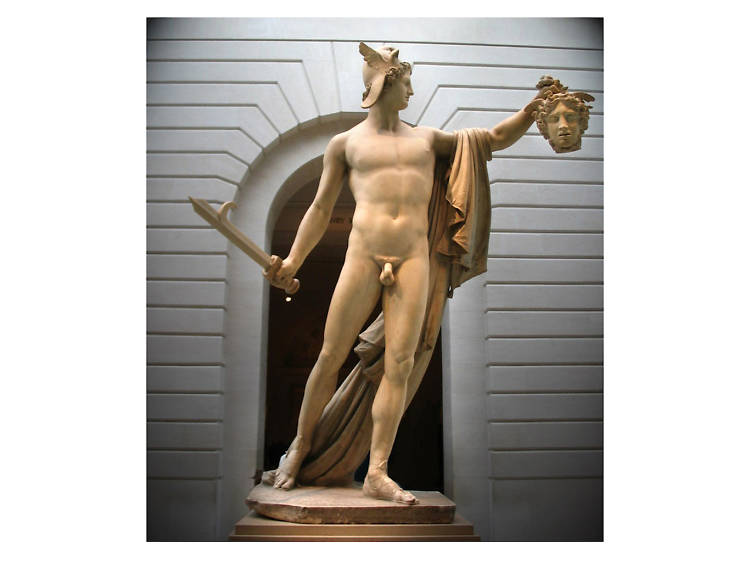
seven. Antonio Canova, Perseus with the Caput of Medusa, 1804–6
Italian artist Antonio Canova (1757–1822) is considered to be the greatest sculptor of the 18th-century. His piece of work epitomized the Neo-Classical fashion, as you can see in his rendition in marble of the Greek mythical hero Perseus. Canova actually made ii versions of the piece: I resides at the Vatican in Rome, while the other stands in the Metropolitan Museum of Art'due south European Sculpture Court.
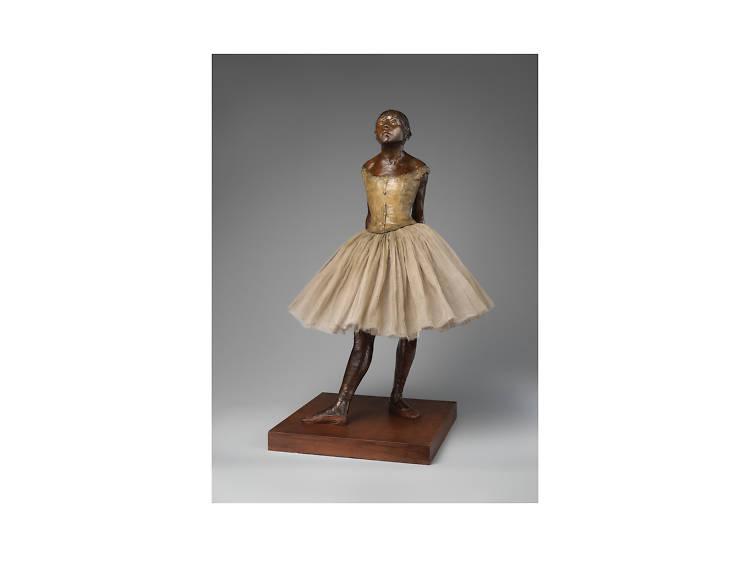
8. Edgar Degas, The Little Fourteen-Year-Old Dancer, 1881/1922
While Impressionist master Edgar Degas is best known as a painter, he likewise worked in sculpture, producing what was arguably the most radical try of his oeuvre. Degas fashioned The Little Fourteen-Year-One-time Dancer out of wax (from which subsequent bronze copies were cast subsequently his death in 1917), only the fact that Degas dressed his eponymous field of study in an bodily ballet costume (complete with bodice, tutu and slippers) and wig of real hair acquired a sensation when Dancer debuted at the Sixth Impressionist Exhibition of 1881 in Paris. Degas elected to encompass almost of his embellishments in wax to match the rest of girl's features, but he kept the tutu, likewise as a ribbon tying backing her hair, every bit they were, making the effigy i of the first examples of found-object art. Dancer was the but sculpture that Degas exhibited in his lifetime; after his death, some 156 more than examples were found languishing in his studio.
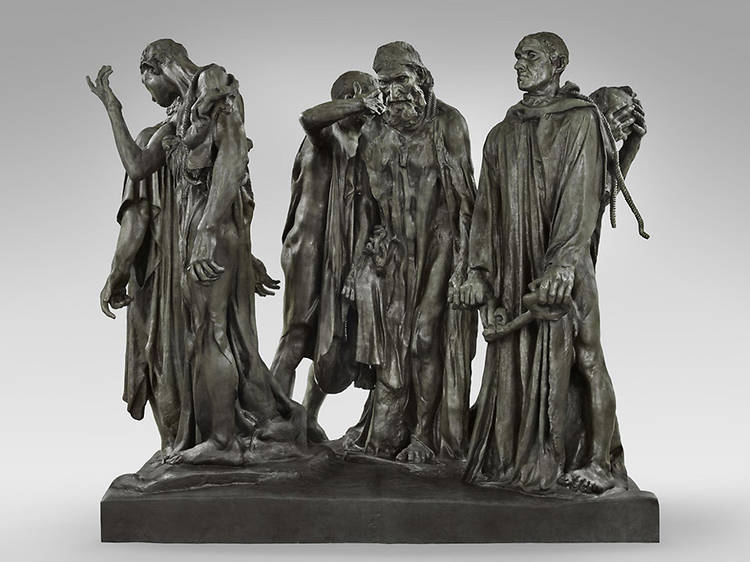
nine. Auguste Rodin, The Burghers of Calais, 1894–85
While nearly people associate the great French sculptor Auguste Rodin with The Thinker, this ensemble commemorating an incident during the Hundred Years' War (1337–1453) between Great britain and French republic is more important to the history of sculpture. Commissioned for a park in the city of Calais (where a year-long siege by the English in 1346 was lifted when six town elders offered themselves up for execution in exchange for sparing the population), The Burghers eschewed the format typical of monuments at the fourth dimension: Instead of figures isolated or piled into a pyramid atop a tall pedestal, Rodin assembled his life-size subjects directly on the basis, level with the viewer. This radical movement toward realism broke with the heroic treatment usually accorded such outdoor works. With The Burghers, Rodin took i of the showtime steps toward modern sculpture.
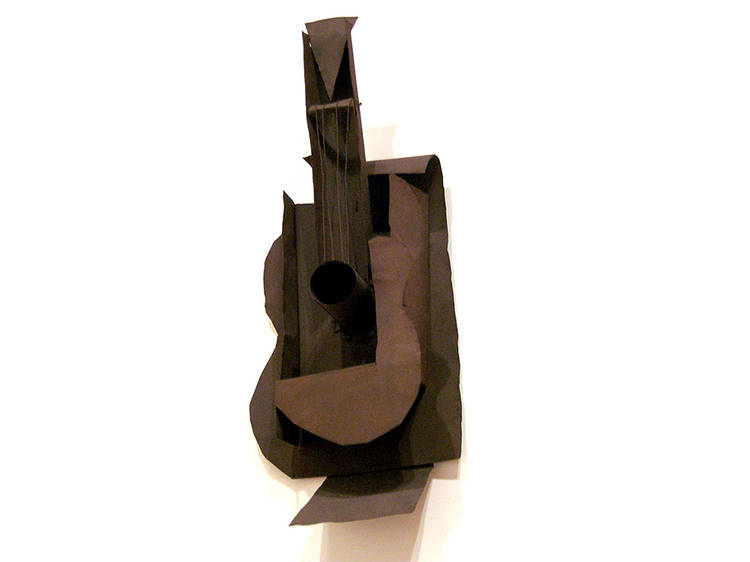
10. Pablo Picasso, Guitar, 1912
In 1912, Picasso created a paper-thin maquette of a slice that would accept an outsized impact on 20th-century art. Also in MoMA's drove, it depicted a guitar, a bailiwick Picasso frequently explored in painting and collage, and in many respects, Guitar transferred collage'southward cut and paste techniques from two dimensions to iii. Information technology did the same for Cubism, besides, past assembling flat shapes to create a multifaceted form with both depth and volume. Picasso's innovation was to eschew the conventional etching and modeling of a sculpture out of a solid mass. Instead, Guitar was fastened together like a structure. This idea would reverberate from Russian Constructivism downwards to Minimalism and beyond. Two years afterwards making the Guitar in paper-thin, Picasso created this version in snipped tin.
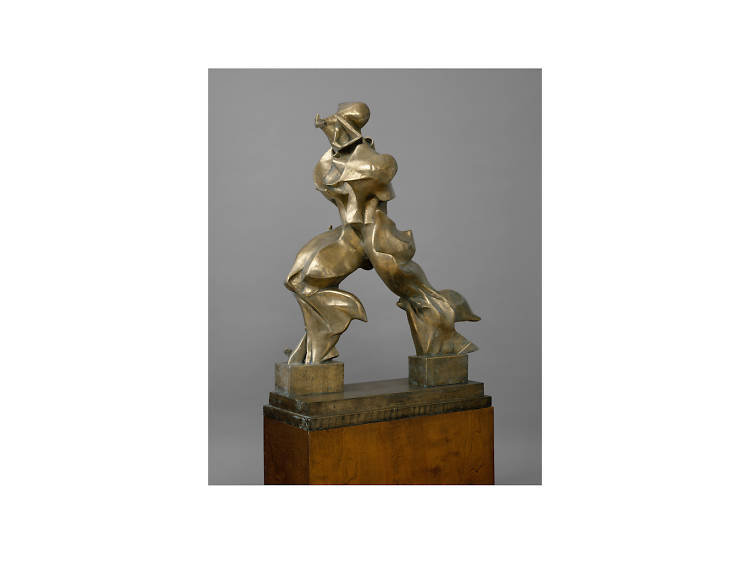
11. Umberto Boccioni, Unique Forms of Continuity in Space, 1913
From its radical beginnings to its concluding fascist incarnation, Italian Futurism shocked the globe, but no single work exemplified the sheer delirium of the movement than this sculpture by one of its leading lights: Umberto Boccioni. Starting out as a painter, Boccioni turned to working in three dimensions after a 1913 trip to Paris in which he toured the studios of several avant-garde sculptors of the period, such as Constantin Brancusi, Raymond Duchamp-Villon and Alexander Archipenko. Boccioni synthesized their ideas into this dynamic masterpiece, which depicts a striding effigy set in a "synthetic continuity" of motility as Boccioni described information technology. The slice was originally created in plaster and wasn't cast in its familiar bronze version until 1931, well subsequently the creative person's death in 1916 as a member of an Italian artillery regiment during World War I.
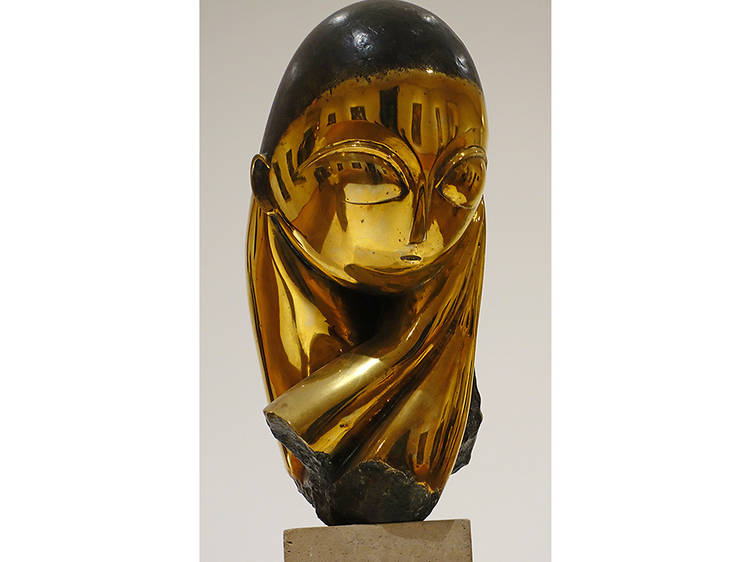
12. Constantin Brancusi, Mlle Pogany, 1913
Built-in in Romania, Brancusi was one of near important sculptors of early-20th century modernism—and indeed, one of the most important figures in the entire history of sculpture. A sort of proto-minimalist, Brancusi took forms from nature and streamlined them into abstract representations. His style was influenced by the folk fine art of his homeland, which oft featured vibrant geometric patterns and stylized motifs. He also made no distinction between object and base, treating them, in certain cases, as interchangeable components—an approach that represented a crucial break with sculptural traditions. This iconic piece is a portrait of his model and lover, Margit Pogány, a Hungarian art student he met in Paris in 1910. The outset iteration was carved in marble, followed by a plaster copy from which this statuary was made. The plaster itself was exhibited in New York at the legendary Arsenal Prove of 1913, where critics mocked and pilloried information technology. Simply it was also the most reproduced piece in the show. Brancusi worked on various versions of Mlle Pogany for some 20 years.
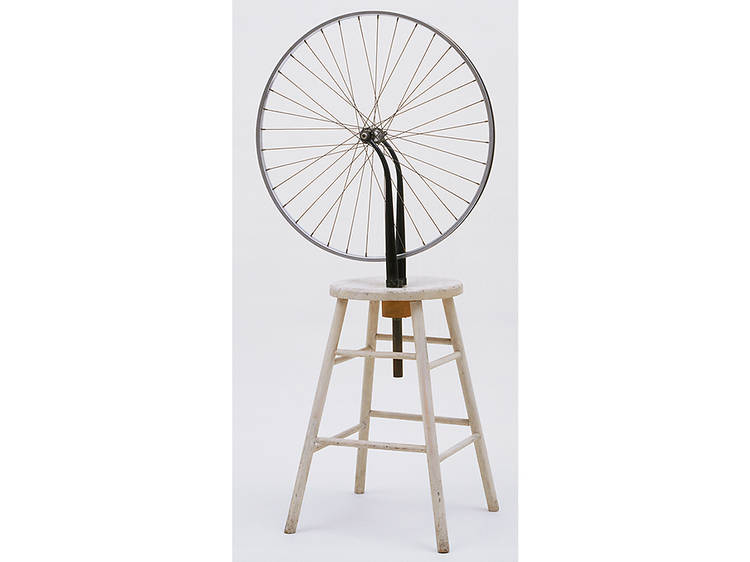
13. Duchamp, Bicycle Bike, 1913
Bicycle Wheel is considered the first of Duchamp's revolutionary readymades. Still, when he completed the piece in his Paris studio, he really had no thought what to telephone call information technology. "I had the happy idea to spike a bicycle wheel to a kitchen stool and watch information technology turn," Duchamp would later on say. It took a 1915 trip to New York, and exposure to the city's vast output of factory-congenital goods, for Duchamp to come up with the readymade term. More importantly, he began to see that making art in the traditional, handcrafted fashion seemed pointless in the Industrial Age. Why bother, he posited, when widely available manufactured items could do the job. For Duchamp, the thought behind the artwork was more of import than how it was made. This notion—perhaps the first real example of Conceptual Fine art—would utterly transform art history going forward. Much similar an ordinary household object, still, the original Bicycle Bike didn't survive: This version is actually a replica dating from 1951.
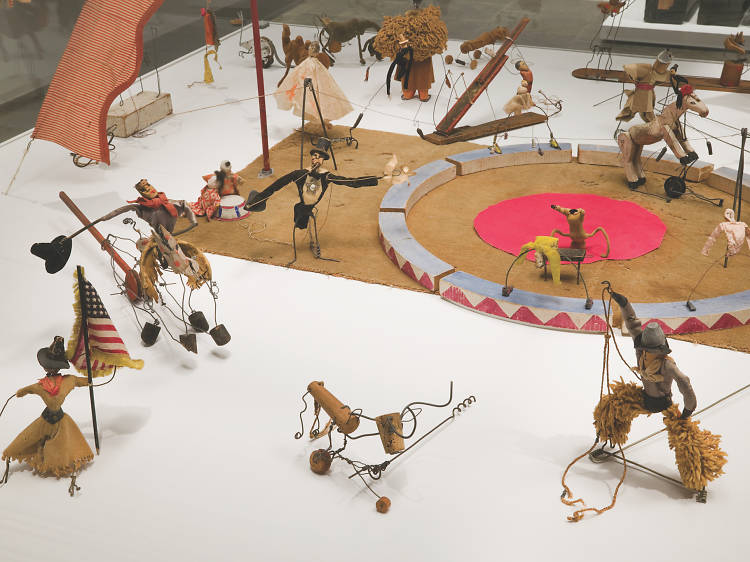
14. Alexander Calder, Calder's Circus, 1926-31
A love fixture of the Whitney Museum'due south permanent collection, Calder'south Circus distills the playful essence that Alexander Calder (1898–1976) brought to carry as an artist who helped to shape 20th-sculpture. Circus, which was created during the creative person's time in Paris, was less abstract than his hanging "mobiles," but in it's own way, it was just as kinetic: Fabricated primarily out of wire and woods, Circus served equally the centerpiece for improvisational performances, in which Calder moved around various figures depicting contortionists, sword swallowers, lion tamers, etc., like godlike ringmaster.
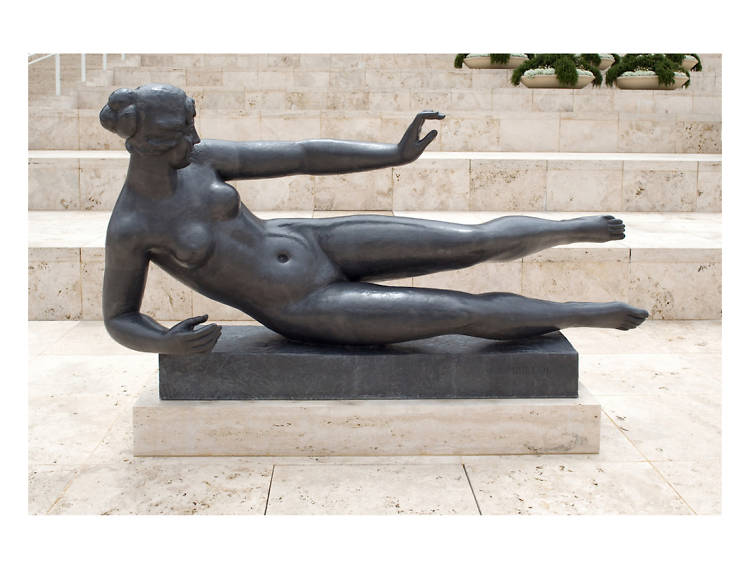
15. Aristide Maillol, L'Air, 1938
As painter and tapestry designer as well equally a sculptor, French artist Aristide Maillol (1861–1944) could exist best described as a modern Neo-Classicist who put a streamline, 20th-century spin on traditional Greco-Roman statuary. He could also be described as a radical bourgeois, though it should be remembered that even avant-garde contemporaries like Picasso produced works in an accommodation of Neo-Classical style after World War I. Maillol's subject was the female nude, and in L'Air, he's created a contrast betwixt the cloth mass of his subject, and the way she appears to exist floating in infinite—balancing, as information technology were, obdurate physicality with evanescent presence.
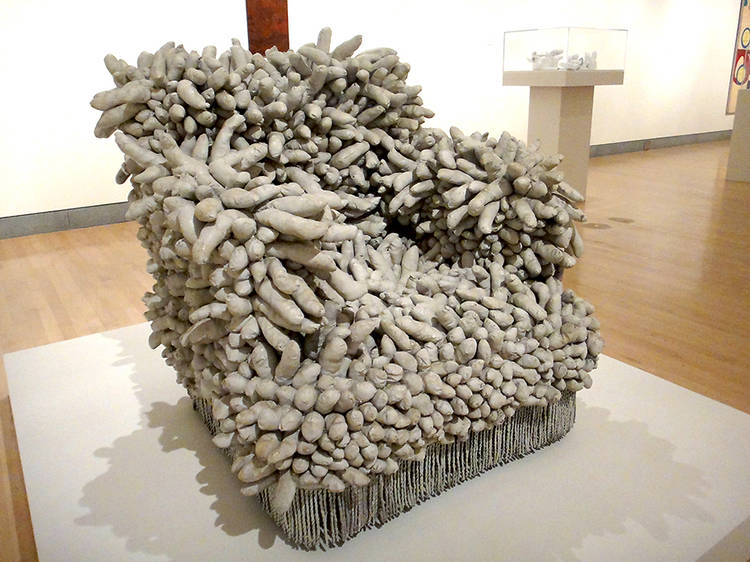
xvi. Yayoi Kusama, Accumulation No 1, 1962
A Japanese artist who works in multiple mediums, Kusama came to New York in 1957 returning to Nihon in 1972. In the interim, she established herself as a major figure of the downtown scene, one whose art touched many bases, including Pop Art, Minimalism and Performance Art. Equally a woman creative person who often referred to female sexuality, she was also a precursor of Feminist Art. Kusama's work is often characterized past hallucinogenic patterns and repetitions of forms, a proclivity rooted in sure psychological conditions—hallucinations, OCD—she'due south suffered since childhood. All of these aspects of Kusuma'due south fine art and life are reflected in this work, in which an ordinary, upholstered easy chair is unnervingly subsumed past a plaguelike outbreak of phallic protuberances made of sewn stuffed fabric.
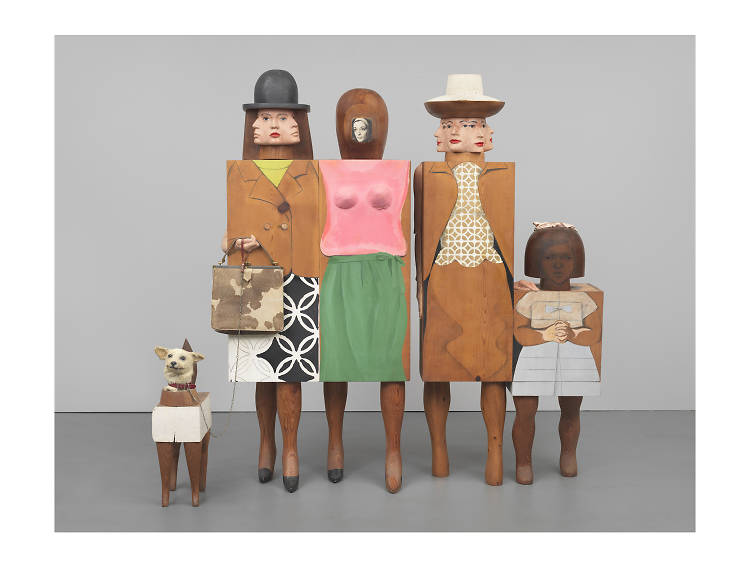
17. Marisol, Women and Dog, 1963-64
Known simply by her get-go name, Marisol Escobar (1930–2016) was born in Paris to Venezuelan parents. Equally an artist, she became associated with Pop Art and subsequently Op Fine art, though stylistically, she belonged to neither grouping. Instead, she created figurative tableaux that were meant as feminist satires of gender roles, celebrity and wealth. In Women and Domestic dog she takes on the objectification of women, and the way that male-imposed standards of femininity are used to force them to conform.
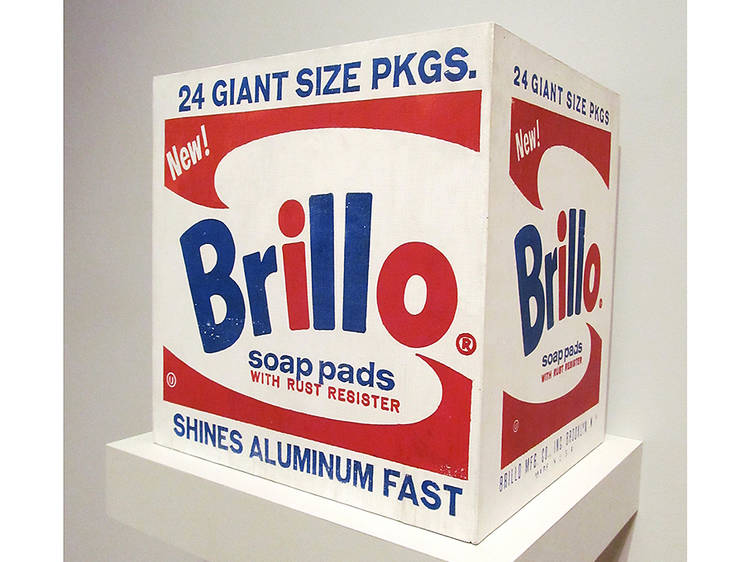
18. Andy Warhol, Brillo Box (Soap Pads), 1964
The Brillo Box is perchance the best known of a series of sculptural works Warhol created in the mid-'60s, which finer took his investigation of pop civilisation into three dimensions. True to the name Warhol had given his studio—the Manufacturing plant—the artist hired carpenters to piece of work a kind of assembly line, nailing together wooden boxes in the shape of cartons for various products, including Heinz Ketchup, Kellogg's Corn Flakes and Campbell's Soup, too Brillo soap pads. He then painted each box a colour matching the original (white in the case of Brillo) before adding the product name and logo in silkscreen. Created in multiples, the boxes were frequently shown in large stacks, effectively turning whatsoever gallery they were in into a high-cultural facsimile of a warehouse. Their shape and series production was perhaps a nod to—or parody of—the then-nascent Minimalist fashion. Just the real point of Brillo Box is how its close approximation to the real thing subverts creative conventions, past implying that in that location's no real difference between manufactured goods and work from an creative person's studio.
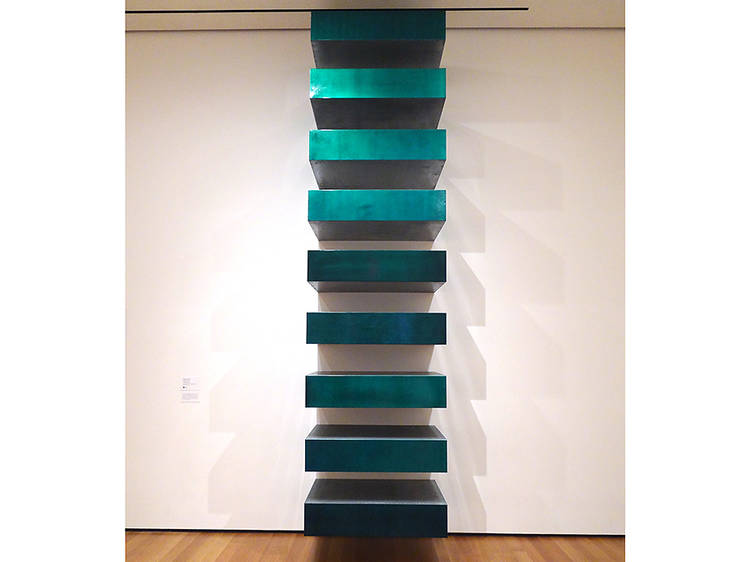
19. Donald Judd, Untitled (Stack), 1967
Donald Judd'southward proper noun is synonymous with Minimal Art, the mid-'60s move that distilled modernism'southward rationalist strain to bare essentials. For Judd, sculpture meant articulating the work'due south concrete presence in space. This thought was described by the term, "specific object," and while other Minimalists embraced it, Judd arguably gave the thought its purest expression by adopting the box as his signature form. Like Warhol, he produced them equally repeating units, using materials and methods borrowed from industrial fabrication. Unlike Warhol'due south soup cans and Marilyns, Judd's fine art referred to zero outside of itself. His "stacks," are among his best-known pieces. Each consists of a group of identically shallow boxes made of galvanized sheet metallic, bulging from the wall to create a column of evenly spaced elements. Only Judd, who started out as a painter, was just as interested in colour and texture as he was in form, as seen here by green-tinted auto-body lacquer applied to the front confront of each box. Judd's interplay of colour and material gives Untitled (Stack) a captious elegance that softens its abstruse absolutism.
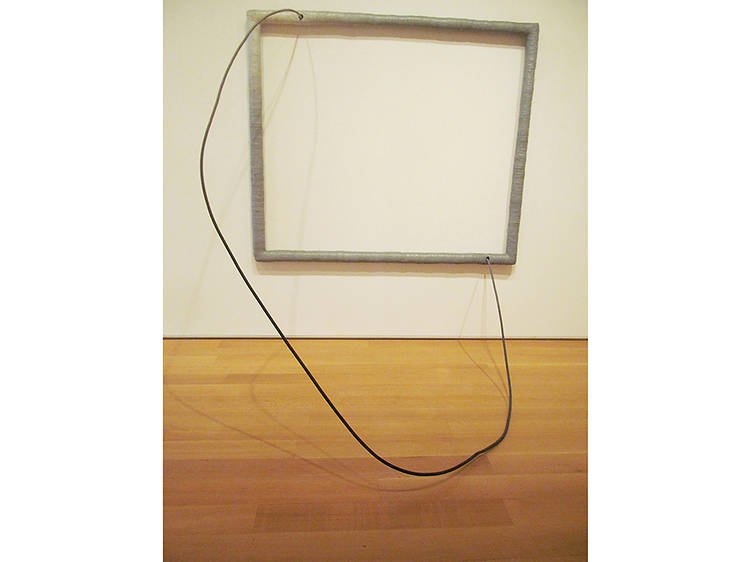
20. Eva Hesse, Hang Up, 1966
Like Benglis, Hesse was a adult female artist who filtered Postminimalism through an arguably feminist prism. A Jew who fled Nazi Germany as a child, she explored organic forms, creating pieces in industrial fiberglass, latex and rope that evoked skin or flesh, genitals and other parts of the body. Given her groundwork, it'south tempting to find an undercurrent of trauma or anxiety in works such every bit this i.
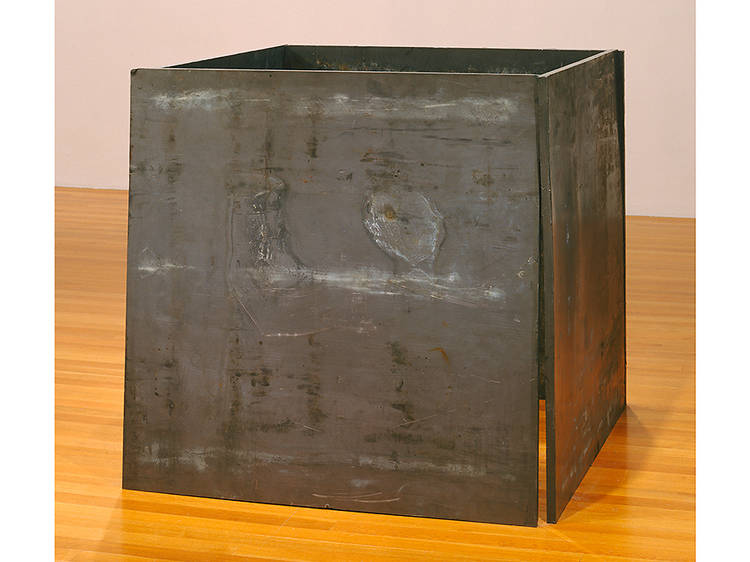
21. Richard Serra, One Ton Prop (House of Cards), 1969
Following Judd and Flavin, a group of artists departed from Minimalism'southward artful of clean lines. As part of this Postminimalist generation, Richard Serra put the concept of the specific object on steroids, vastly enlarging its scale and weight, and making the laws of gravity integral to the idea. He created precarious balancing acts of steel or pb plates and pipes weighing in the tons, which had the upshot of imparting a sense of menace to the work. (On two occasions, riggers installing Serra pieces were killed or maimed when the work accidentally collapsed.) In recent decades, Serra's work has adopted a curvilinear refinement that'southward fabricated it hugely popular, just in the early on going, works similar One Ton Prop (Firm of Cards), which features four lead plates leaned together, communicated his concerns with roughshod directness.
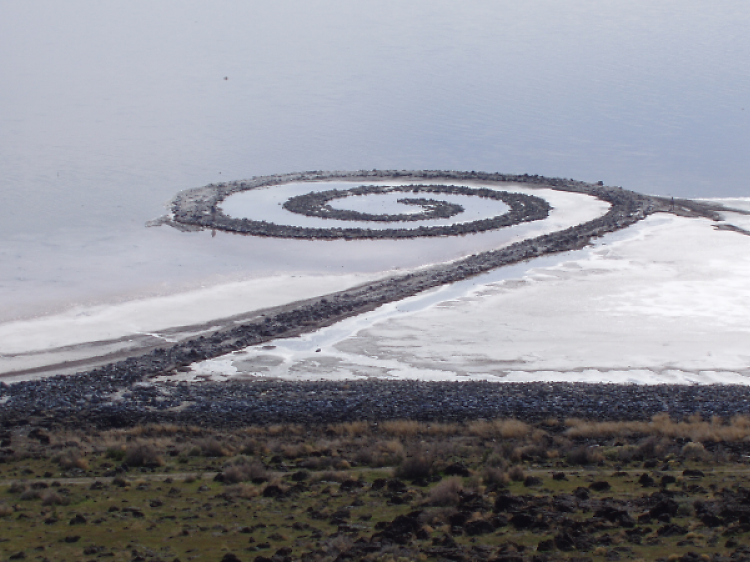
22. Robert Smithson, Spiral Jetty, 1970
Post-obit the full general countercultural trend during the 1960s and 1970s, artists began to revolt against the commercialism of the gallery world, developing radically new fine art forms like earthworks. Also known as country art, the genre'south leading figure was Robert Smithson (1938–1973), who, along with artists such equally Michael Heizer, Walter De Maria and James Turrel, ventured into the deserts of the Western United States to create monumental works that acted in concert with their surroundings. This site-specific approach, every bit information technology came to be chosen, oft employed materials taken directly from the landscape. Such is the case with Smithson'south Spiral Jetty, which juts into Utah's Great Salt Lake from Rozel Betoken on the lake'south northeastern shore. Made of mud, table salt crystals and basalt extracted onsite, Spiral Jetty measures i,500 by 15 anxiety. It was submerged under the lake for decades until a drought in the early 2000s brought it to the surface again. In 2017, Spiral Jetty was named the official artwork of Utah.
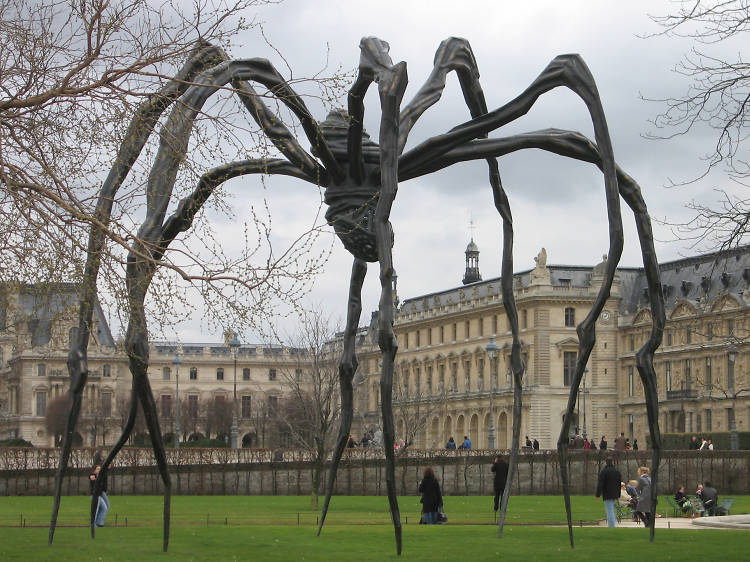
23. Louise Bourgeois, Spider, 1996
The French-born creative person's signature work, Spider was created in the mid-1990s when Bourgeois (1911-2010) was already in her eighties. It exists in numerous versions of varying scale, including some that are awe-inspiring. Spider is meant equally a tribute to the creative person's mother, a tapestry restorer (hence the innuendo to the arachnid'due south propensity for spinning webs).
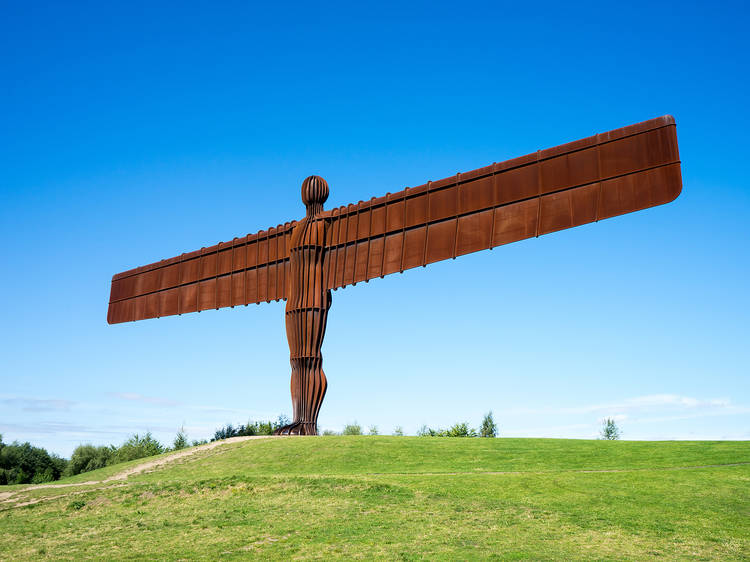
24. Antony Gormley, The Affections of the N, 1998
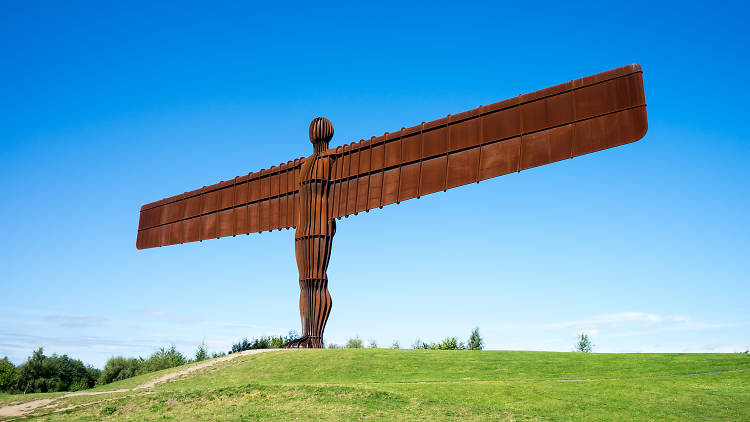
Winner of the prestigious Turner Prize in 1994, Antony Gormley is one of the near celebrated gimmicky sculptors in the UK, but he'south besides known the world over for his unique accept on figurative art, i in which broad variations in calibration and style are based, for the most role, on the aforementioned template: A cast of the artist'southward own torso. That's true of this enormous winged monument located near the town of Gateshead in northeastern England. Sited along a major highway, Angel soars to 66 feet in acme and spans 177 anxiety in width from wingtip to wingtip. According the Gormley, the piece of work is meant as a sort of symbolic marker between Uk'due south industrial past (the sculpture is located in the England's coal country, the heart of the Industrial Revolution) and its mail service-industrial future.
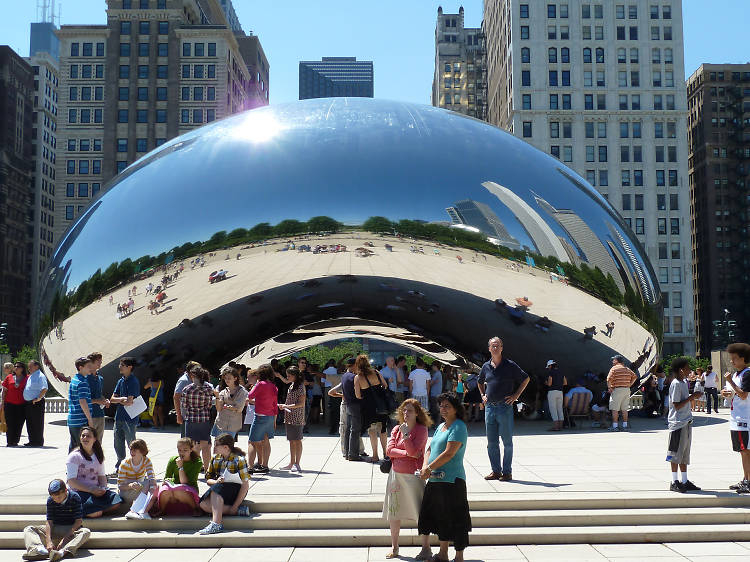
25. Anish Kapoor, Cloud Gate, 2006
Affectionately called "The Bean" past Chicagoans for its bent ellipsoidal form, Deject Gate, Anish Kapoor'southward public fine art centerpiece for the 2d City's Millennium Park, is both artwork and compages, providing an Instagram-fix archway for Sunday strollers and other visitors to the park. Fabricated from mirrored steel, Deject Gate'south fun-business firm reflectivity and large-scale makes it Kapoor's best-known piece.
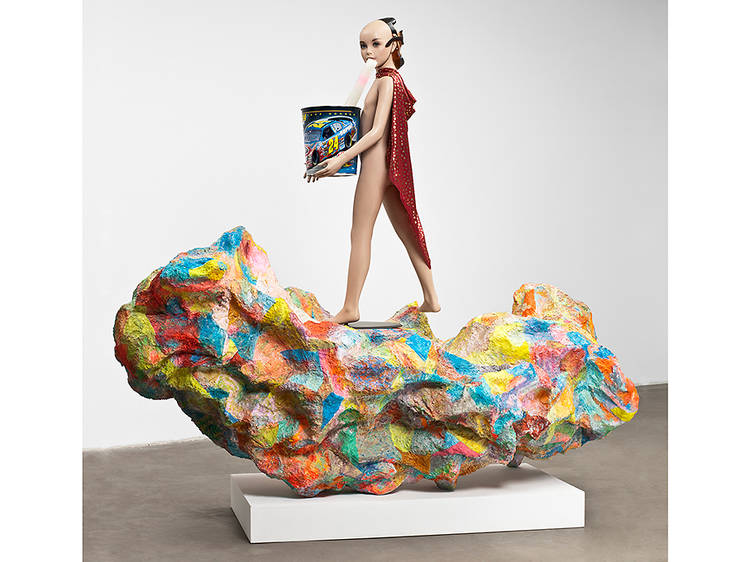
26. Rachel Harrison, Alexander the Keen, 2007
Rachel Harrison's piece of work combines a complete ceremonial with a knack for imbuing seemingly abstract elements with multiple meanings, including political ones. She fiercely questions monumentality and the masculine prerogative that goes with it. Harrison creates the majority of her sculptures by stacking and arranging blocks or slabs of Styrofoam, before covering them in a combination of cement and painterly flourishes. The carmine on top is some sort of found object, either lone or in combination with others. A prime number case is this mannequin atop an elongated, pigment-splashed form. Wearing a greatcoat, and a backwards-facing Abraham Lincoln mask, the work sends upwardly the smashing homo theory of history with its evocation of the Ancient Earth'southward conqueror standing tall on a clown-colored rock.
Check out Picasso'southward best paintings
An e-mail you'll actually love
🙌 Awesome, you're subscribed!
Thanks for subscribing! Look out for your first newsletter in your inbox before long!
johnstonfainterep.blogspot.com
Source: https://www.timeout.com/newyork/art/top-famous-sculptures-of-all-time
0 Response to "Marble Bust of a Man Mid 1st Century Marble 14 38 Inches the Metropolitan Museum of Art"
Enviar um comentário